The codex chronology
Attack on Titan Timeline
Attack on Titan unfolds across more than one kind of time. There is the time of the episode you are currently watching — and the time of the world itself: older wars, hidden histories, lives inside the Walls, and events far from the walls that only gain meaning later. This timeline lets you explore those layers step by step, pairing chronology with place, so you understand when something matters and where — without ever being pushed past the episode you have chosen.
- Spoiler-safe
- Chronology + map
01§ 01 · The promise
The episode selector is a spoiler boundary
Discovery, preserved
A normal chronology is dangerous for first-time viewers — full of late reveals and retrospective framing. Here, the selector filters every event and location to what you can safely know at your point in the story. It does not only sort content; it preserves discovery.
If a later event does not appear yet, that omission is deliberate. The page is not incomplete for you — it is respecting your progress. Set your episode and explore the filtered timeline with confidence.
02§ 02 · Precision
What a timeline entry can represent
The map does not reduce the story to one kind of marker. Some entries are short events that last a single episode, some are locations that keep mattering over time, and some span full anime arcs whose information unfolds as you progress through the story.
03§ 03 · Reading
The reading flow
Move the time rail to browse every available event by year. Click one of those events, or any visible point on the map, and an information panel opens with the essentials: year, narrative, location, and involved characters.



04§ 04 · Routes
Some events become paths across the map
Not everything happens at a single point. Some events cross several places, so the map represents them as routes. If you have not seen the whole arc yet, the route simply stops early: new legs draw themselves onto the map as you advance episodes, until the journey is complete.
05§ 05 · Places
One pin can stand for a whole place
Several records can happen at the same spot. Rather than pile up nudged dots, the map draws ONE pin for the place and marks it with a ring and a tally of what sits underneath — the ring is what tells you the dot is worth opening.
Opening it unfolds a chooser: the place itself on top, a record of its own with its own page, and beneath it every event pinned there in the world's chronology. Pick one and the chooser closes — the panel takes over the reading.
06§ 06 · Chains
A record can continue into the next one
Some events do not end so much as hand over. Where one record continues into another, the panel closes that thread with a card naming where the story goes next, and the map draws the hand-off as a bridge from where this record ends to where the next one begins.
The bridge is deliberately not a movement route. Routes are gold and mark ground somebody crossed; the bridge is a white dashed arc and marks a narrative hand-off. Reading one as the other would put marches on the map that nobody ever made.
07§ 07 · Layers
A record is not finished being told
Some entries are written in layers. There is the base account — what could honestly be said at the moment the story first shows it — and then chunks that unseal later, when the anime hands you the context that changes what the same event means.
Each layer carries the episode that unlocks it, and an entry with more still behind a padlock says so plainly instead of pretending to be complete. Advancing your marker does not only add records to the map; it goes back and finishes the ones you have already read.
08§ 08 · Testimony
Who is telling you this
History in this world is contested. Some records therefore carry more than one telling, and some sentences point back at a record the codex already holds. Both are ways of saying the same thing: an account is not the same object as a fact.
Rival accounts
Pick a narrator and the record is re-set as their quotation, signed underneath. The tellings agree on most of it, so only the disputed claims are marked — and on a swap those are the only words that move.
Recalled memories
A sentence can point at a record you already hold. Pressing it lays that record on top of this one, inset so the panel beneath still shows — and getting back costs one tap.
09§ 09 · Atlas
When the atlas stops being one map
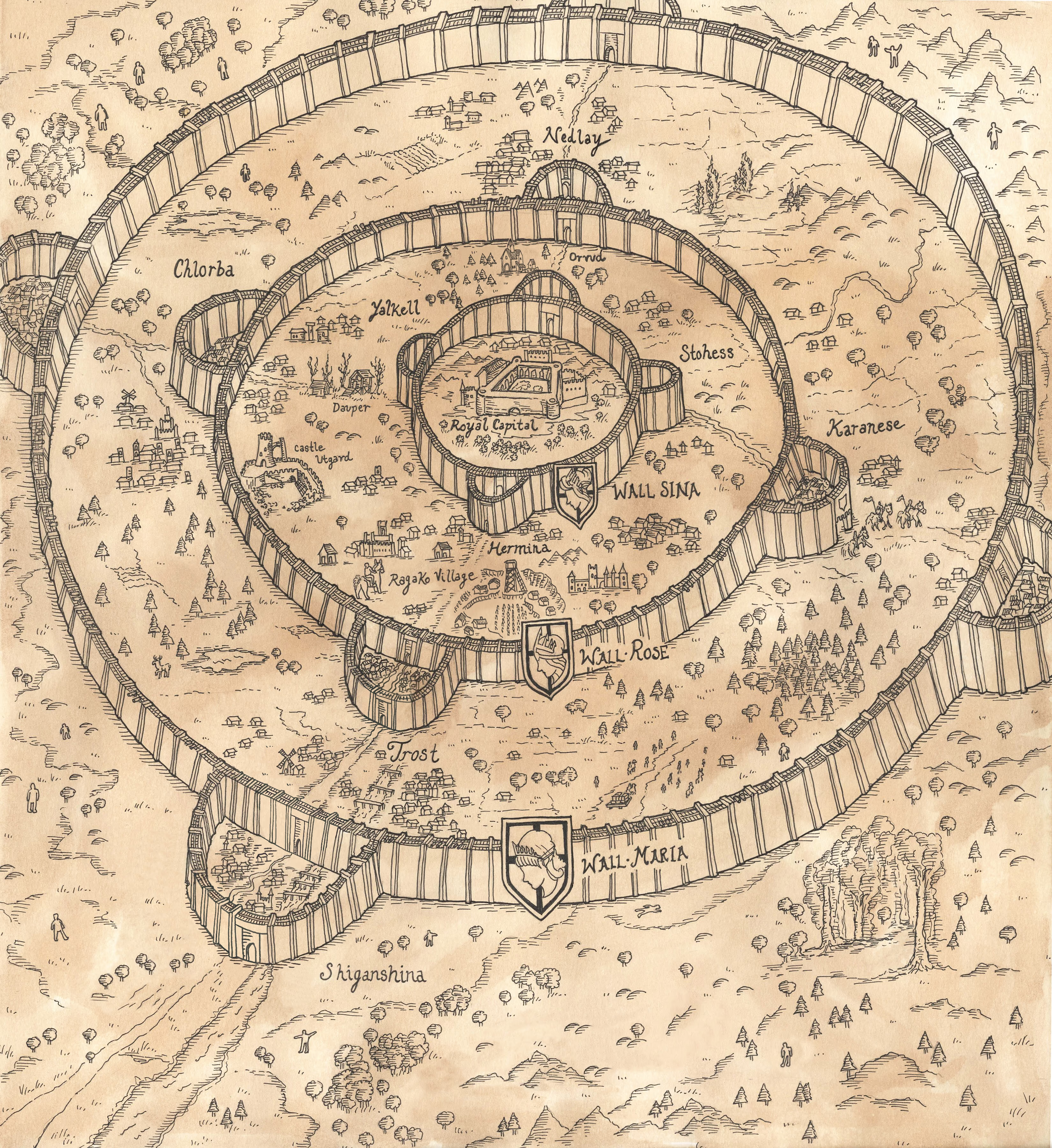
The codex opens with a single hand-drawn map, because for a long time that is the whole of the known world. Later the story establishes that it is not, and the atlas grows a second sheet.
The two are not separate screens. The first map is a frame on the second, so moving between them is a zoom rather than a cut: the camera pulls out of the map you were reading and finds it again as a marked rectangle on the larger one. And a map is a reveal like any other record — the second sheet does not exist for you until your episode reaches it.
At your episode the codex still has one map, and that map is the whole world. The second sheet appears the moment the story says otherwise.
10Frequently asked
Questions about the timeline
Is this the full Attack on Titan timeline?
It is the full system of events and places in your Codex, but the interactive experience stays filtered to the episode you select. A separate, clearly-marked spoiler index holds the complete history when you want it.
Why are some entries approximate instead of exact?
Because the history includes ancient, mythic, and retrospective material that was never presented as a precise day-by-day record. Older eras read as approximations; story-era events carry precise dating.
How is this different from a watch-order guide?
A watch-order guide tells you what to watch next. A timeline explains how events fit together in time and space. Both intents exist in search — they solve different problems.