Survey Corps
“Dedicate your heart”
The Survey Corps is the only regiment in Attack on Titan that dares to cross the walls and face the Titans in open ground.
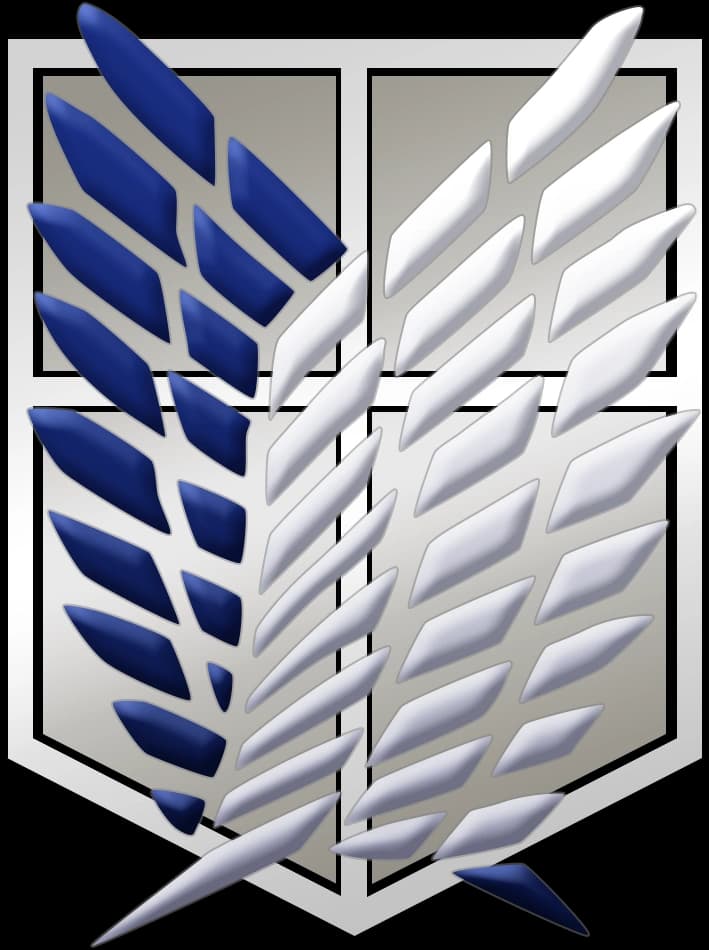
Their expeditions exact a brutal toll in lives, yet every march brings humanity closer to the truth of what lies outside. Their blue-and-white Wings of Freedom are a symbol of hope and sacrifice.
Also known as Scout Regiment · Scouting Legion · Recon Corps
- Base
- Frontier · Trost District
- Role
- Expedition & reclamation
- Type
- Military regiment
The record
Role in the story
What the Survey Corps is
The Survey Corps is one of the three branches a graduating cadet may choose, and the only one whose work happens outside the walls. Where the other two regiments are built to hold a line, this one is built to cross it: to march out through the gate, map ground nobody has stood on for a century, and come back with something worth the cost.
It is also the smallest and the least funded. Its casualty rate is the worst in the army by an enormous margin, its expeditions are argued over in the capital as a waste of taxes and lives, and the crowds that gather to watch it ride out are as likely to jeer as to cheer. Anyone who picks it is choosing the hardest possible road on purpose.
Mission and method
Their stated goal is reclamation: to retake the ground humanity has lost and reopen the world beyond the wall. In practice a march is an exercise in information. The regiment rides out in the long-range scouting formation, a wide screen of mounted squads spread across kilometres, each relaying flare signals back towards the centre so that the column can steer around a Titan long before it is close enough to kill anyone.
Everything about the regiment follows from that method. It fights from horseback and from the air on vertical manoeuvring gear, never on foot if it can help it. It trades territory for speed. And it accepts, as the price of the whole enterprise, that a march which brings back one useful fact and loses thirty people is still counted as a march that worked.
How it is organised
A commander sits at the head of the regiment and answers to the army's high command. Below him the Corps is divided into squads, each built around a leader who picks their own soldiers and keeps them together long enough that they can read one another mid-air without speaking.
That squad structure is the reason the regiment functions at all. Formation flying at that speed cannot be coordinated by orders shouted across a field; it only works if four or five people already know exactly what the person beside them is about to do. It is also why every loss lands twice — a squad that loses a member does not simply become smaller, it stops being the thing it was.
Why it matters in the story
The Survey Corps is the only military branch whose standing mission requires travel beyond the walls. While the Garrison defends the districts and the Military Police maintains order in the interior, the Corps conducts expeditions, maps territory, studies titans and searches for a route to reclaim lost land.
That mission places its members at the centre of the questions driving the early story: what lies beyond the walls, where the titans come from and why the government restricts inquiry. The narrative follows the Corps because its expeditions bring the characters into contact with evidence the other branches are not assigned to pursue.
The regiment
Hierarchy and members
0 revealed · 20 sealed
Turning points
Key events
0 revealed · 10 sealed
On the map
Headquarters and key places
2 revealed · 2 sealed
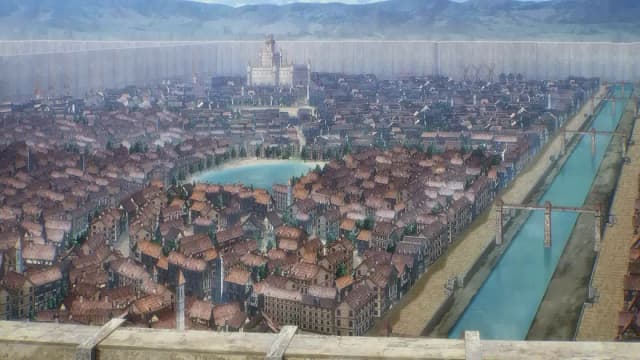 Shiganshina DistrictA town that juts out from the southern foot of Wall Maria, the southernmost settlement of them all. Home to the Yeager family, it is the…
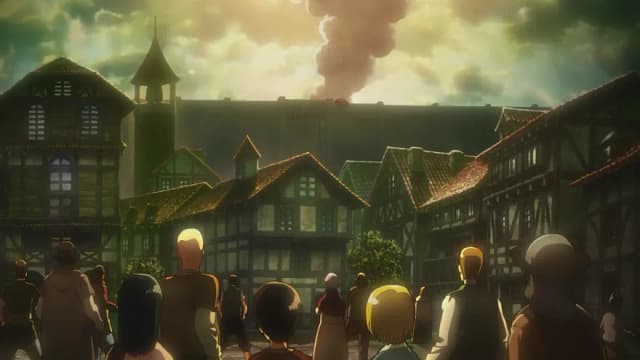 Wall MariaOutermost of the three rings of stone, Wall Maria marks the edge of the known world. Its frontier districts press closest to the wild lands…
Standing
Relations with other factions
0 revealed · 4 sealed
Across the story
How the faction changes
0 revealed · 4 sealed
Common questions
Frequently asked
What is the Survey Corps in Attack on Titan?
It is the branch of the military that operates outside the walls. Its job is to march into Titan territory, map it, reclaim it and bring back information, and it is the only one of the three regiments whose work happens beyond the gate.
Is the Survey Corps the same as the Scout Regiment or the Scouting Legion?
Yes — all three are translations of the same regiment. "Scouting Legion" comes from the earliest English fan translations, "Scout Regiment" from the official manga, and "Survey Corps" from the anime; in Spanish the same split gives "Cuerpo de Exploración" and "Legión de Reconocimiento".
What is the Survey Corps emblem?
Two overlapping wings, one white and one blue, known as the Wings of Freedom. It is worn on the back of the regiment's green cloaks and is the most recognisable symbol in the series.
Why does the Survey Corps have so many deaths?
Because it fights Titans in open ground rather than from the top of a wall. Outside there is no fixed terrain to anchor manoeuvring gear to, no cannon support and no retreat, so a single mistake in formation costs an entire squad.
How do you join the Survey Corps?
By completing three years of cadet training and then choosing it at the graduation ceremony. It is the one branch with no rank requirement — anyone who graduates may join, which is precisely why so few do.
What is the long-range scouting formation?
The regiment's marching order: mounted squads spread across a wide screen, relaying coloured flares inwards so the column learns where the Titans are early enough to steer around them instead of fighting them.
Other factions

All 23 members of Survey Corps — spoilers
Complete spoiler archive
Complete roster: Survey Corps
This index lists every member of Survey Corps, including those who haven't appeared at your episode yet. Open a dossier only when you're ready to cross that spoiler boundary.
Complete arc
A regiment on trial
After Trost the Corps is in the worst position of its history: it has spent a generation's worth of soldiers for ground it cannot hold, and the capital wants it dissolved. It survives by gambling everything on a single recruit — arguing, in open court, that the regiment is the only place in the walls equipped to make use of him.
The enemy is inside
The 57th expedition ends the Corps' oldest assumption. The thing that tears the formation apart is not a Titan that wandered into their path; it is something that knew the formation, knew the signals, and knew where the centre was. From here the regiment stops thinking of itself as an expedition force and starts thinking of itself as a counter-intelligence problem.
Outlawed
The Corps ends up hunted by the government it serves. Stripped of its authority and hiding in the interior with the people it is supposed to be protecting, it makes the decision that defines it: rather than obey a crown it no longer believes in, it moves against it — and in doing so stops being a regiment that asks permission.
The cost of the answer
The return to Shiganshina is the expedition the whole regiment has existed for, and it very nearly ends it. What comes back through the gate is not an army; it is a handful of survivors carrying the one thing a century of marches had never produced — an answer.
Relations with other factions
- High Command — Every expedition needs authorisation from the army's supreme commander, which makes the Corps' budget — and its continued existence — a political question rather than a military one.
- Cadet Corps — Recruits reach the regiment only after three years of training, and only by choosing it over two far safer options on the night the graduating class picks its branch.
- Garrison — The Corps rides out through gates the Garrison opens and comes back to walls the Garrison is holding; when a breach happens, the two end up fighting the same battle from opposite directions.
- Military Police — The two regiments compete for the same graduates and disagree about almost everything else: one exists to leave the walls, the other to make sure the interior never has to think about them.